Understanding “Shi”: The Hidden Momentum Behind Chinese Calligraphy
In Chinese calligraphy, beauty is not defined only by the shape of a character. Behind every stroke lies a deeper concept known as “Shi,” a term that describes the invisible momentum that flows through writing. It is the energy that carries one stroke into the next, the rhythm that transforms individual marks into a living composition. Rather than focusing solely on the appearance of characters, calligraphy invites us to observe how motion itself becomes the source of meaning.
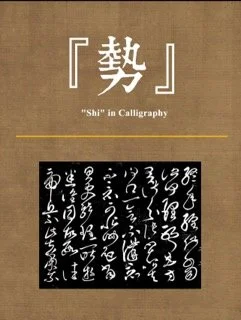
“Shi” can be understood as the dynamic force that drives brushwork forward. Each stroke grows out of the one before it and prepares the path for the one that follows. In this way, Chinese calligraphy is less about isolated characters and more about continuity. The brush moves with intention, yet the resulting form is shaped by timing, pressure, and subtle shifts in direction. When these elements come together, the writing appears fluid and alive, carrying a sense of movement across the page.
A skilled calligrapher learns to work with this momentum rather than against it. Just as a dancer responds to music, the brush responds to the flow of ink and the texture of paper. What seems like spontaneity is actually the result of deep awareness. The artist senses how the brush should rise, turn, or pause, allowing the writing to unfold naturally. This responsiveness gives calligraphy its expressive power and ensures that no two pieces are ever exactly the same.
The concept of “Shi” also appears in other Chinese arts and philosophies. In martial arts, for example, a shift in balance or a change in direction can generate power and flow. Calligraphy follows a similar principle. Slight adjustments in the brush’s angle or speed can redirect the energy of a stroke, giving the character a sense of vitality. Even small variations can transform a static form into something dynamic and expressive.
One of the clearest examples of “Shi” can be seen in cursive script. In this style, characters are not separated by rigid boundaries. Instead, they flow into one another, creating a continuous line of motion. The brush travels quickly at times and slowly at others, forming a pattern that resembles a conversation between movements. The result is writing that feels immediate and alive, as though the page is capturing the rhythm of thought itself.
What makes this concept especially powerful is that it shifts our attention away from perfection and toward connection. The goal is not simply to write a character correctly but to allow the brush to move with purpose and continuity. Each mark contains a trace of the artist’s timing, emotion, and awareness in that moment. Over time, students of calligraphy begin to see how these subtle movements reveal the personality and presence of the writer.
If you are interested in learning more about Chinese calligraphy and experiencing these principles firsthand, explore upcoming workshops and classes by visiting https://jojocalligraphy.com.